
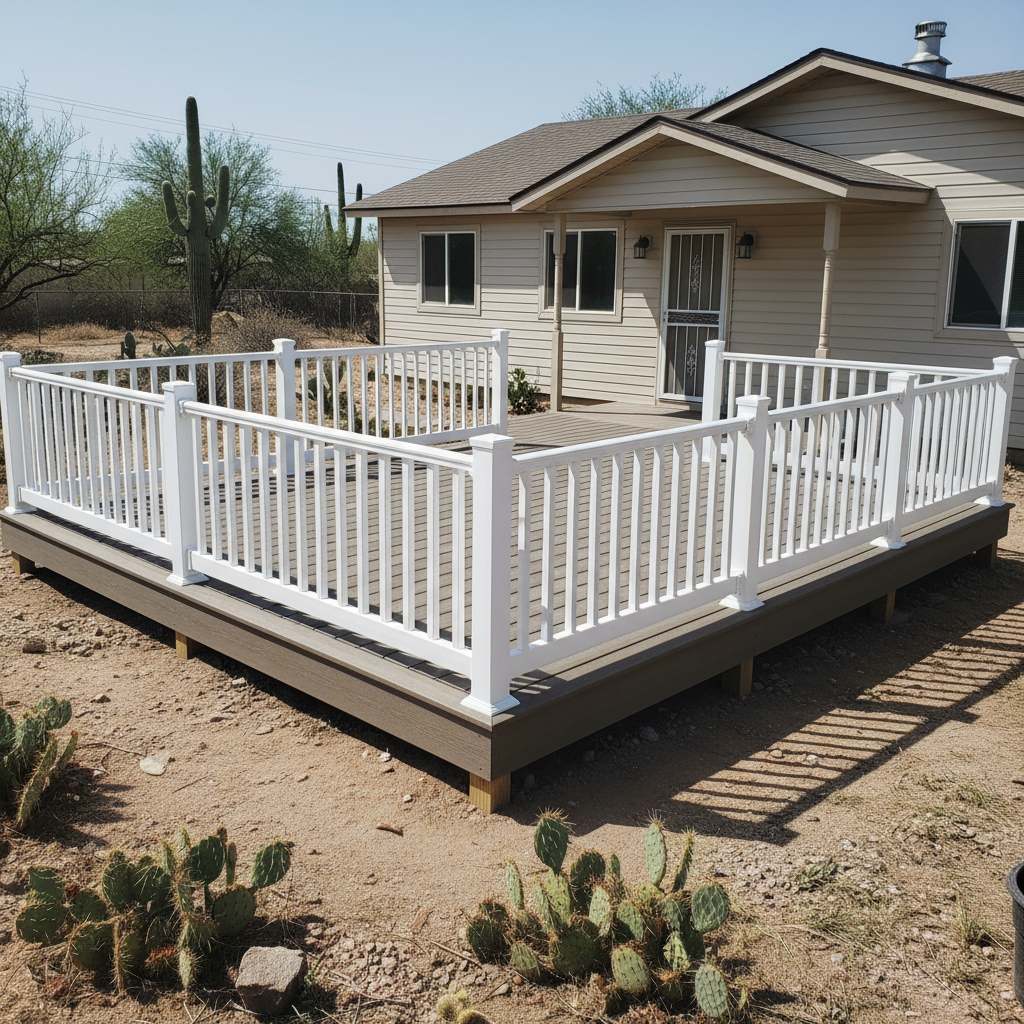
Sahuarita has a particular set of conditions that make deck building here different from a lot of the country, and a builder who's only worked in Ohio or Oregon is going to learn some of this on your dollar. Here's what actually separates a good deck builder from one who'll leave you with a problem in three years.
Ask what they're doing about caliche before they ever talk design
Under a lot of Sahuarita lots, somewhere between 12 and 36 inches down, you hit caliche, a cemented layer of calcium carbonate that's closer to soft concrete than soil. A post hole digger bounces off it. Footings need to either get below it or be engineered to bear on top of it properly, and that changes the labor and sometimes the equipment on day one. If a builder quotes your deck without ever mentioning soil conditions or asking about your lot, they're either guessing or they're planning to deal with it as a surprise change order once the crew hits rock. Ask directly: "how deep are the footings going and what happens if you hit caliche at 18 inches?" A builder who's worked here before has a real answer, not a shrug.
Check the license, the insurance, and actually call the number
Arizona contractors doing this kind of work need a ROC license, and you can look up the license number on the Arizona Registrar of Contractors site in about two minutes. Confirm it's active and matches the business name on your quote. Ask for proof of liability insurance and workers' comp, and don't just take their word for it, have them email you the certificate. If a deck collapses or someone falls off a 10-foot elevated platform during a build, you want to know the crew on your roof is covered and not you.
A lowball bid that's 30 to 40 percent under everyone else usually means one of three things: unlicensed labor, undersized lumber or footings that won't pass inspection, or a bait-and-switch where the real price shows up once the deck is half built. Walk away from cash-only deals and from anyone who tells you a permit "isn't really necessary" for a deck over 30 inches off the ground.
Understand the permit and HOA process here
If your lot is inside Town of Sahuarita limits, the Town's building division handles the permit and inspections. If you're in one of the unincorporated pockets nearby, it's Pima County Development Services instead. Either way, expect a plan review, a footing inspection before concrete gets poured, and a final inspection before you're legally done. A deck attached to the house with a ledger board also usually triggers a look at the flashing detail, because that's the single most common place decks leak and rot where they meet the stucco.
If you're in Rancho Sahuarita, Quail Creek, or most of the newer subdivisions, there's also an HOA architectural review on top of the municipal permit, often with its own rules on setback from the property line, allowable materials, and sometimes color. A builder who's done work in your neighborhood before will know the HOA's typical turnaround and what drawings they want. One who's never heard of your HOA is going to add weeks to your timeline figuring it out.
Ask what they'll actually spec, not just what they'll say
Get this in writing, not verbally: joist spacing (16 inches on center is standard for most decking, but some composite brands require 12 inches for warranty coverage), footing depth and diameter, post size, and whether ledger bolts are lag screws or through-bolts. For a deck attached to a house built in the 1990s or 2000s, which covers a lot of Sahuarita's housing stock, the rim joist condition matters too. If a builder won't commit to specifics on paper, you have no way to check their work later or hold them to it if something sags.
On material, our summer sun here is brutal on anything organic. Untreated or poorly sealed wood decking can go gray and start splintering within two summers if it's not stained and sealed on a schedule, and a south or west-facing deck takes the worst of it. Composite decking handles UV better over the long run but still expands and contracts with our heat swings, sometimes close to a quarter inch over a 12-foot board run between a June afternoon and a December morning, so gapping at installation matters more here than it would somewhere milder. Ask what gap spacing they use and why.
Walk the railing and the edge conditions like an inspector would
Railings are where corners get cut because they're the last thing built and the easiest to rush. Code requires 36 inches minimum height for most residential decks, 42 inches if it's a commercial or multi-family application, and baluster spacing that won't pass a 4-inch sphere through it, which is there specifically so a toddler can't slip through or get a head stuck. Check whether the quote includes stainless or hot-dip galvanized fasteners for anything exposed to weather. Standard zinc-coated screws will rust and bleed streaks into composite or wood within a couple of seasons out here, especially with the monsoon humidity spikes we get from July through September after months of bone-dry air.
Also walk the actual footprint with the builder before you sign anything. Grading matters more than people think: a deck built flush against the house with no slope away from the foundation can send monsoon runoff straight back toward your footing, and a hard August downpour here can dump an inch of rain in under an hour. A builder who thinks about where that water goes after a storm is thinking past the day the project is finished.
What a decent quote looks like
A real proposal names the lumber species or composite brand and board width, the fastener type, footing depth and count, whether they're pulling the permit or you are, and a rough timeline including how many days before you can walk on new concrete footings (typically 3 to 7 days minimum before load, longer before full cure) and when staining can happen on new wood (usually a 30 to 60 day dry-out period first). If a quote is one line that just says "build 300 sq ft deck, composite, $X," ask for the detail. A builder who can't break it down for you doesn't have a plan, just a price.
We put this level of detail in every quote we write, because a homeowner deciding whether to spend five figures deserves to know exactly what they're getting before a single post hole gets dug. You can see more about how we approach this kind of work at Ashford Outdoor Spaces.